

Being the sole voice in the universe can feel quite isolating.
For those unaware, the quest for life — particularly intelligent life — has been underway for many years. Yet, thus far, it appears we are alone.
Astronomers pursue the search for life through two primary methods: they look for biosignatures, which are indications of past or present biological activities (like the Mars rovers), and technosignatures, which are signs of technology produced by intelligent beings. The search for technosignatures mainly relies on radio astronomy rather than optical methods, as any such activities would likely be too distant for visual detection. Essentially, astronomers are tuning in for signals.
One leading entity in this endeavor has been the SETI Institute. Established in 1984, it has been scanning the skies for radio waves that might be reaching us from the vast universe, hoping to receive a greeting from extraterrestrial beings. The institute has focused on star systems known to host exoplanets, but up until now, no signs from extraterrestrial life have been found.
However, researchers at the Mountain View, California-based organization have developed an innovative approach to locating these signals by incorporating game theory. This fresh strategy not only determines where to search for these signals but also when.
Game theory is a mathematical discipline that examines decision-making in interactive scenarios where the players or agents rely on each other’s choices. Each player considers the strategy of the other, without knowing their exact actions, and the outcome relies on their combined strategies.
In the context of the SETI Institute, they are utilizing the “Schelling point” concept from game theory. The most referenced scenario by economist Thomas Schelling involves a situation where two individuals plan to meet in New York City without specifying a time or location. Both parties might opt for Grand Central Terminal at noon, as it is a familiar meeting point and a sensible time.
Now, applying this to the search for extraterrestrial intelligences, consider the anti-solar point, an imaginary location in space directly opposite the sun (180 degrees away). Imagine a line extending from the sun through Earth into the cosmos.
What if an alien civilization could observe Earth passing in front of the sun, a phenomenon known as a transit? What if they were aware of a planet orbiting our star and decided to transmit a message towards us?
We know the where — Earth — and the when — during a transit.
In essence, we’re arranging a meeting at Grand Central at noon.
Echoes in the emptiness
This anti-solar approach was proposed years ago, but sufficient funding was not available until now.
“I’ve been contemplating these long-standing ideas in the literature,” stated Sophia Sheikh, a technosignature research scientist at the SETI Institute and the principal author of the study. “Now, the anti-solar point concept is finally receiving its moment in the spotlight.”
In their recent publication released on November 3, astronomers from the SETI Institute announced the detection of 1.9 million radio signals using this technique. However, after filtering through these signals, none were found to correspond with extraterrestrial technology; all were terrestrial in origin. It appears we humans, with our satellites and radio broadcasts, are quite noisy.
The analysis excluded that specific section of the sky — but this does not imply that there is nothing else out there. The universe is vast.
They intend to persist with this approach for a minimum of four years, as stated by Sophia Sheikh, the technosignature research scientist and lead author.

The Sun and our solar system in relation to the Milky Way galaxy. The white circle indicates the region where most exoplanets have been discovered with current telescopes. (NASA/JPL-Caltech/T. Pyle)
Sheikh explained that they are searching for a type of signal known as a narrowband signal, describing it as a “‘we are here’ … akin to an air horn in the radio frequencies.”
“It might contain information, or the signal we discover could be what we refer to as a carrier wave. So, the air horn signifies, ‘Hey, there’s something noteworthy here.’”
However, do not envision astronomers sitting with headphones, like Ellie Arroway in the 1997 film Contact. Instead, sophisticated computer programs analyze the data.
The SETI Institute employs the Allen Telescope Array, a set of 42 steerable telescopes each 6.1 meters in diameter located at the Hat Creek Radio Observatory in California. This array has been used to search for extraterrestrial signals since the 1980s.

The Allen Telescope Array, the first radio telescope specifically designed for the search for extraterrestrial intelligence (SETI), is situated at the Hat Creek Radio Observatory in northern California and features 42 antennas. (Simon Steel)
Science fiction?
The pursuit of extraterrestrial signals might seem like a plot from a science fiction story. However, considering that the Milky Way galaxy contains over 100 billion stars, many believe there must be life out there, especially since we have confirmed that most stars host at least one exoplanet.
Additionally, there is the Drake equation, created by American astrophysicist Frank Drake in 1961, which aims to estimate the number of potentially communicative civilizations within the Milky Way.
The outcome hinges on numerous unknown variables, but it is not zero.
Adam Frank, a professor of astrophysics at the University of Rochester in New York, is also on the lookout for technosignatures. He received NASA’s first grant to investigate non-radio technosignatures, focusing instead on chemical signatures or other signs of intelligent life.
He has noted that the search for extraterrestrial intelligence was not taken seriously in earlier times.
“The giggle factor, which lingered throughout much of my career, has vanished,” Frank remarked, pointing out that the concept was not regarded seriously decades ago. “It never made sense.”
This is especially true following the first discovery of exoplanets in 1992 and the first detection of an exoplanet around a sun-like star in 1995.
If a detection occurs…
What if a signal is actually detected? What would happen next?
Believe it or not, established protocols exist as outlined by the International Academy of Astronautics. Apart from the essential tasks of verifying and authenticating the discovery, there is a significant guideline: Do not respond. (If you are familiar with Liu Cixin’s 3 Body Problem, you might appreciate why this protocol is sensible.)
-
‘Weird’ interstellar asteroid yields no alien signals, resembles worlds beyond Neptune
-
Scientists skeptical about recent claims that signs of life were possibly detected on exoplanet
In reality, this isn’t much of a concern. Signals would traverse light-years. For instance, if we receive a signal from a star system located 100 light-years away, and Earth decides to reply, it would take 100 years for our response to reach the extraterrestrial civilization, followed by another 100 years for us to get their reply. That totals 300 years just to exchange a simple greeting.
“Communication is not the top priority,” Frank stated.
Frank’s research focuses on identifying technosignatures through an exoplanet’s chemical makeup.
“For instance, we can examine the atmospheres of alien worlds to search for substances like chlorofluorocarbons … chemicals that can only be produced by industrial processes,” he explained. “These compounds cannot be generated purely by natural processes or biospheres.”
Thus, it will be more about finding solace in the knowledge that we are not alone.
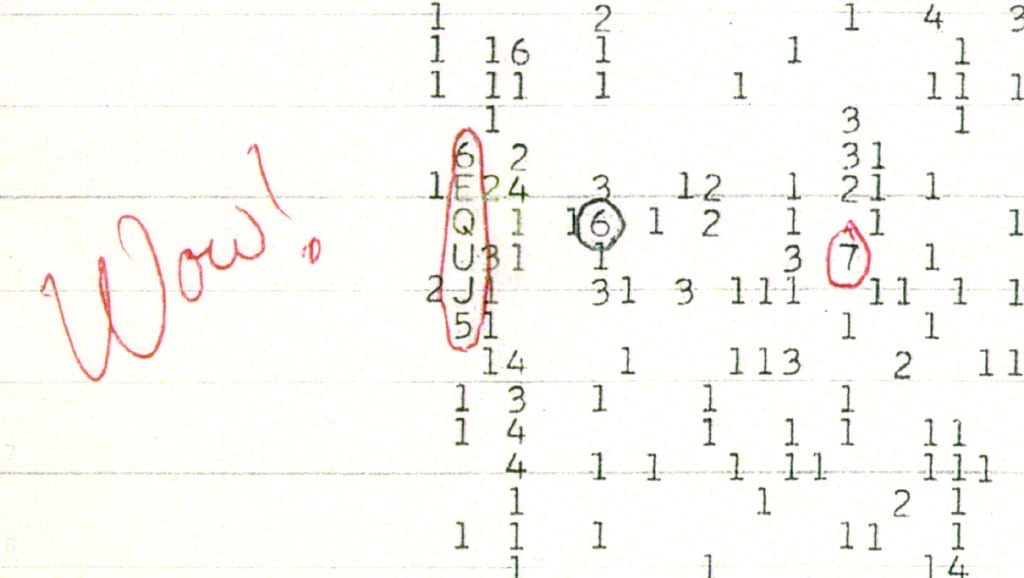
This image depicts the printout of a strong signal captured at the Big Ear Radio Observatory in 1977. Astronomer Jerry Ehman circled the unusual signal and noted ‘Wow!’ in the margin. (Big Ear Radio Observatory and North American Astrophysical Observatory)
While we have yet to identify a definitive radio signal that might suggest the presence of an alien civilization, there was the well-known “Wow! Signal.” This remarkable radio emission was detected in 1977 by the Big Ear telescope in Ohio. It lasted for 72 seconds but has never been observed again. Speculation has since emerged that it may have been produced by passing comets.
So when might we detect an extraterrestrial signal?
“What I often say,” Sheikh remarked, “is that I hope by the end of my career, we will have some insight into whether there are any radio signals in the galaxy being produced by other technology-possessing civilizations.”