

In the coming weeks, provided the skies are clear, you can observe the International Space Station (ISS) traversing the evening sky.
If you happen to spot it, consider waving to Canadian Space Agency astronaut Joshua Kutryk, who is traveling at an impressive speed of 7.66 kilometers per second.
Kutryk is among seven crew members currently residing and working aboard the ISS as part of Expedition 75.
Since his arrival at the ISS on October 1, Kutryk has engaged in numerous experiments and responsibilities, including a recent study on cardiac health.
As expected, he has also been relishing the stunning views from space.
The ISS can frequently be seen flying over Canada, but in the upcoming weeks, it will be visible in the evening instead of the early morning hours it has been recently.
How to locate the ISS in the night sky
It will appear as a bright white dot among the many dimmer lights of satellites, gliding across the sky. Unlike airplanes, it won’t have any blinking lights and will move consistently in one direction.
-
Joshua Kutryk says he’s ‘having a blast’ on the International Space Station
-
Canadian astronaut Joshua Kutryk conducts his 1st spacewalk
Next, you will need to determine when the ISS will be passing overhead. There are several methods to accomplish this.
One option is heavens-above.com, an independent platform that monitors various satellites and spacecraft. By entering your location, you can find the ISS along with other visible objects. The site will then present you with a schedule of appearances similar to the one below.
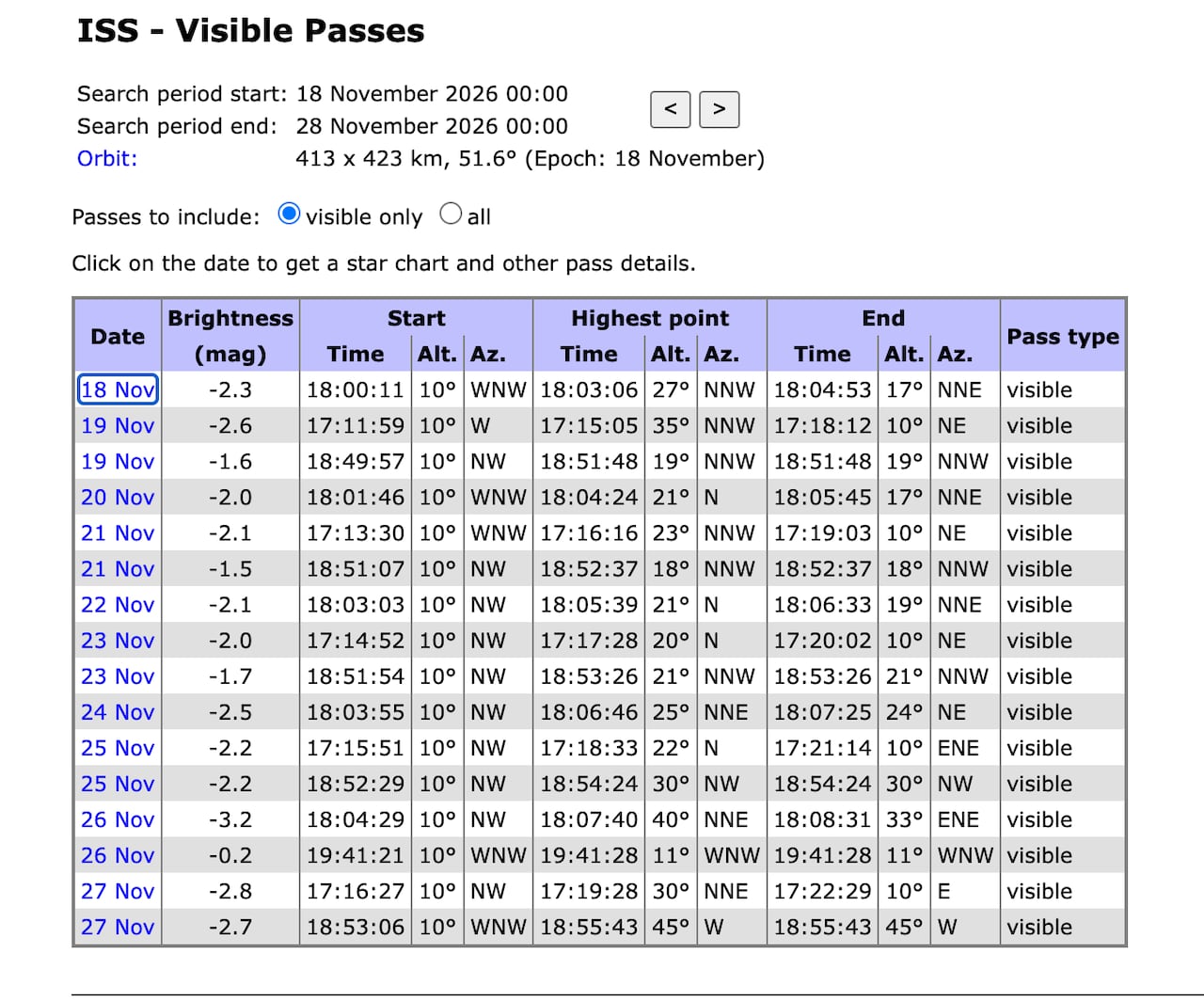
This chart indicates the times the ISS will be visible over Toronto in the upcoming weeks. (Heavens-above.com)
Regarding brightness, the lower the number, the brighter it will appear (this might seem counterintuitive, but that is just how astronomy works).
By clicking on a specific date, you will be shown a sky map depicting a line that crosses various constellations, which represents the ISS’s trajectory.

This night sky map illustrates the constellations and the ISS’s path for this particular pass. (Heavens-above.com)
If you only notice a short line close to the horizon on the map, it may be best to skip that date since the ISS could be harder to spot.
Conversely, if the line is longer, it’s worth trying to see it, assuming you have a clear view.
The constellation map will also provide local times for the ISS’s visibility, which is very useful.
NASA’s Spot the Station app is another excellent tool.
Upon launching the app, it should automatically identify your location. The main screen will show a countdown to the next ISS pass. By clicking the “Sightings” button, you can access a list of future passes.
Additionally, it features an AR View (augmented reality), which provides sky details when you point your phone towards it — including a line that indicates where the ISS will travel.
If you manage to spot the ISS as it moves across the sky, just think: perhaps Joshua Kutryk is glancing back at you.