

Saudi Arabian aircraft struck Yemen while Houthi militants retaliated by launching drones and missiles towards Saudi cities, as reported by the Iran-supported group on Wednesday, following a swift advance that has broadened Tehran’s influence in the ongoing Middle Eastern conflict.
As the conflict escalates in this new arena, the United States has tightened its travel advisory for Saudi Arabia, prohibiting government personnel from venturing within 32 kilometers of the Yemeni border.
The Houthis have rapidly advanced through Yemeni towns along the Red Sea coastline and captured islands in the Bab el-Mandeb Strait in recent days. Overnight, they shared battlefield footage showing their fighters taking armored vehicles from Saudi-supported forces. The video depicted warplanes overhead and massive explosions rising from desert dunes.
Yahya Saree, a military spokesperson for the Houthis, announced that the group had executed new drone and missile attacks on the significant Saudi Red Sea oil port of Yanbu and a southern airbase in Khamis Mushait, without providing a specific timeline for these strikes.
Both locations were included in a broader range of alert areas announced by Saudi Arabia on Tuesday, but no similar alerts were issued on Wednesday.
Saudi officials and the oil company Aramco did not respond promptly to requests for comments via email.
Earlier, Saree claimed that the Houthis had downed a Saudi F-15 fighter jet, although no immediate evidence supporting this claim was presented.
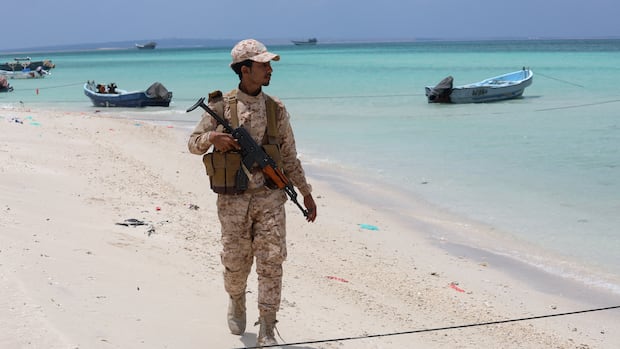
Iran-supported Houthi rebels in Yemen are increasing their control over a crucial Middle Eastern shipping route, adding further strain to global oil supplies and prices.
Saree stated that the Saudis had conducted up to 450 airstrikes on Yemen this week. Officials from the Saudi-aligned government in southern Yemen acknowledged that their forces, along with those of Saudi Arabia, were carrying out airstrikes on Houthi positions, although Riyadh has not confirmed these actions.
Over the past week, the Houthis have repeatedly launched attacks into Saudi Arabia, triggering alarms in southern and western cities. A strike attributed to Iran-aligned fighters in Iraq also disrupted Saudi Arabia’s East-West pipeline last week, which is the primary route for redirecting oil exports from the blockaded Strait of Hormuz.
On Tuesday, Riyadh claimed that its air defenses intercepted a Houthi drone south of Mecca before it could enter restricted airspace over the holy city, labeling the attack as crossing a “red line” that endangers sacred sites for Muslims worldwide.
Houthi spokesperson Saree refuted the claim that the group had targeted Mecca, asserting that the Saudi reports were fabricated for propaganda purposes.
According to sources, U.S. officials met with the Houthis over the weekend in Oman, during which the group expressed its intention not to attack American vessels and reaffirmed its commitment to a ceasefire established with the U.S. last year.
Risk of escalating global energy supply crisis
The war’s expansion into Yemen poses a significant risk of exacerbating the global energy supply crisis resulting from the six-month-old U.S.-Israeli conflict with Iran, which has hindered shipping through the Strait of Hormuz.
On Wednesday, the price of Brent crude remained around $108 US per barrel, nearing its highest level since May. Additionally, the average retail price of diesel fuel in the United States reached an unprecedented high of over $6.30 US per gallon for the first time.
Traders indicate that a prolonged halt of Saudi Arabia’s East-West pipeline could potentially sever as much as four percent of the global oil supply. While Saudi Arabia has not specified when operations might resume, U.S. Energy Secretary Chris Wright informed CNBC on Tuesday that crude oil should begin flowing through the pipeline within days.
Since 2015, Saudi Arabia has led a coalition against the Houthis. The conflict had largely quieted due to a ceasefire in recent years, but it reignited when the Houthis imposed a naval blockade against Saudi Arabia in July and targeted southern regions of the kingdom. Violence has sharply escalated this month as the militant group has pushed back forces aligned with the internationally recognized Yemeni government supported by Saudi Arabia.
Last week, Crown Prince Mohammed bin Salman of Saudi Arabia reached out to U.S. President Donald Trump to request military assistance, which has thus far been limited to intelligence support.
-
Houthis attack more Saudi targets as regional talks with Iran postponed
-
Houthis seize strategic island, Saudis close pipeline as fighting escalates
In 2025, the United States conducted airstrikes against the Houthis for two months but halted the campaign after reaching what Trump described as a ceasefire intended to stop attacks on vessels.
Trump now faces a challenging decision: whether to remain passive and risk an exacerbation of the Houthi advance, which could worsen the global energy crisis, or to offer more direct military assistance to the Saudis, potentially extending U.S. involvement in another conflict.